
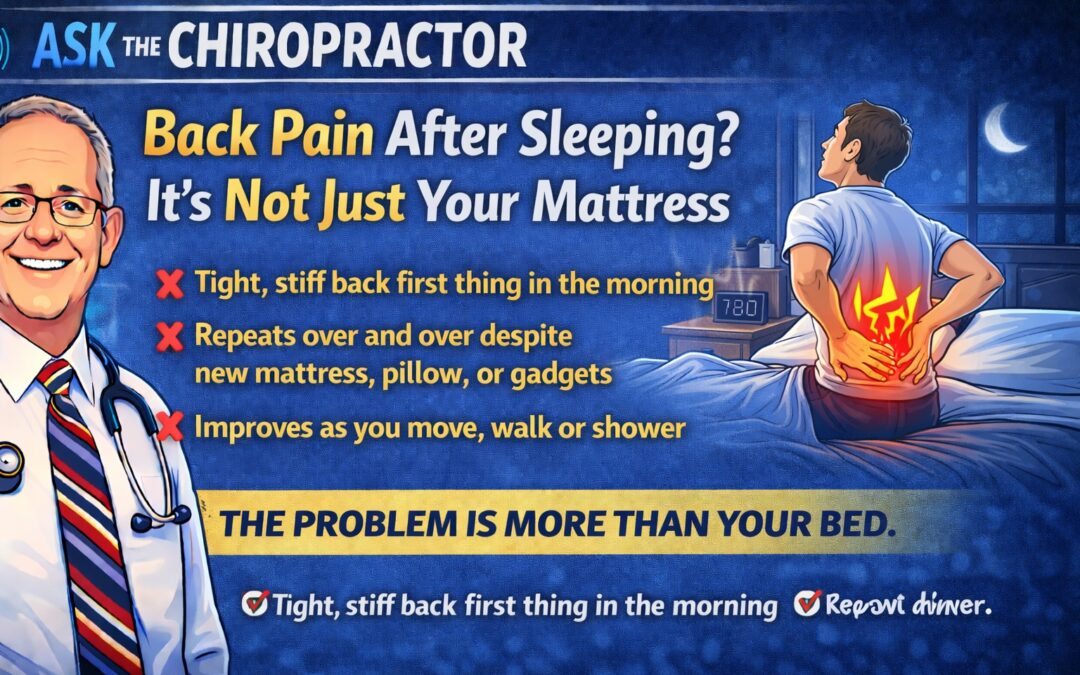
Back Pain After Sleeping? It’s Not Just Your Mattress
Many people notice their back hurts most when they wake up in the morning. Naturally, they assume the problem is their mattress or their pillow.
So they replace the bed, try different sleep positions, or buy support cushions—yet the pain keeps returning.
That’s because in most cases, sleep doesn’t create the problem. It reveals it.
Why Back Pain Shows Up After Sleeping
During the day, your body is constantly moving. Joints stay lubricated, muscles compensate, and stiffness is temporarily masked by activity.
At night, the opposite happens:
- Movement stops
- Joints stiffen
- Fluid pressure within the discs shifts
- Nerve sensitivity increases
When you get up, the body suddenly has to move again—and the underlying restriction becomes noticeable.
The Typical Morning Back Pain Pattern
Most patients describe a very specific sequence of events:
- Feeling stiff when first getting out of bed
- Finding it hard to stand up straight immediately
- Pain that improves after showering or walking
- The cycle returning the very next morning
This pattern strongly suggests a mechanical motion problem rather than acute tissue damage.
Why Mattresses Rarely Fix the Problem
A mattress can influence your comfort level, but it usually does not create chronic back pain. Changing your mattress to fix recurring morning pain is like changing your shoes to fix a limp caused by a hip problem—you’ve altered the environment, but not the cause.
External support cannot replace internal movement.
What Chiropractors Look For
When evaluating morning back pain, chiropractors look for how the spine functions after a period of inactivity. We specifically focus on:
Joint Restriction
Spinal segments that stiffen overnight and struggle to resume normal motion in the morning.
Hip and Pelvic Involvement
The pelvis and lower spine must move in tandem. If one area is restricted, the other becomes irritated and inflamed.
Nerve Sensitivity
Morning “guarding” and tightness often reflect altered nerve signaling rather than a simple muscle injury.
Remember: Morning pain is usually a movement problem—not a sleep problem.
Why Movement Helps Quickly
People often feel better after a warm shower, a short walk, or light stretching. This happens because movement restores joint signaling and circulation temporarily. However, if the underlying restriction remains, the pattern will repeat indefinitely.
Who This Applies To
This explanation fits especially well if:
- You wake up stiff every single day
- You “loosen up” after 10–20 minutes of activity
- The pain consistently repeats in the same area
- You’ve already replaced your mattress with no long-term relief
Stop Chasing the Bed
If your back hurts after sleeping, the problem likely isn’t what you’re lying on; it’s how your spine responds to stillness. At Hulsebus Rockford Chiropractic, we evaluate the mechanical cause behind recurring morning stiffness so the cycle stops repeating.
The goal isn’t a softer bed. It’s a spine that moves normally again.
- Why does my back hurt in the morning? It’s usually due to overnight joint restriction and fluid pressure shifts in the discs, not just a bad mattress.
- Does a new mattress fix back pain? Rarely. A mattress changes the environment, but it doesn’t fix the internal movement restriction.
- How do I stop morning stiffness? Movement (like walking or a warm shower) helps temporarily, but chiropractic adjustments are needed to restore normal joint function.
Trusted Chiropractic Care in Rockford for Generations
At Hulsebus Rockford Chiropractic, chiropractic isn’t just what we do—it’s our family’s legacy. We understand that recurring low back pain is a sign that your body’s master control system, the nervous system, is under stress. Our goal is to locate the specific subluxations causing that stress and provide precise adjustments to restore your health.
Following the principles of the International Chiropractors Association (ICA), we focus on the relationship between the spine and the nervous system. We don’t just want to get you out of pain today; we want to help your body function at its highest potential for years to come.